Assignment 01: Brep Mesher + Reciprocal Frame
Goal: build a UV-based mesher for a Rhino Brep and use the resulting mesh as the topology for a reciprocal-frame structure materialized with COMPAS Timber.
Your starting point is a01_brep-mesher.ghx. It includes a scaffold and in-place guidance comments. This line-by-line guidance can be ignored if desired to implement in a different way.
Learning Goals
By the end of this assignment, you should be able to:
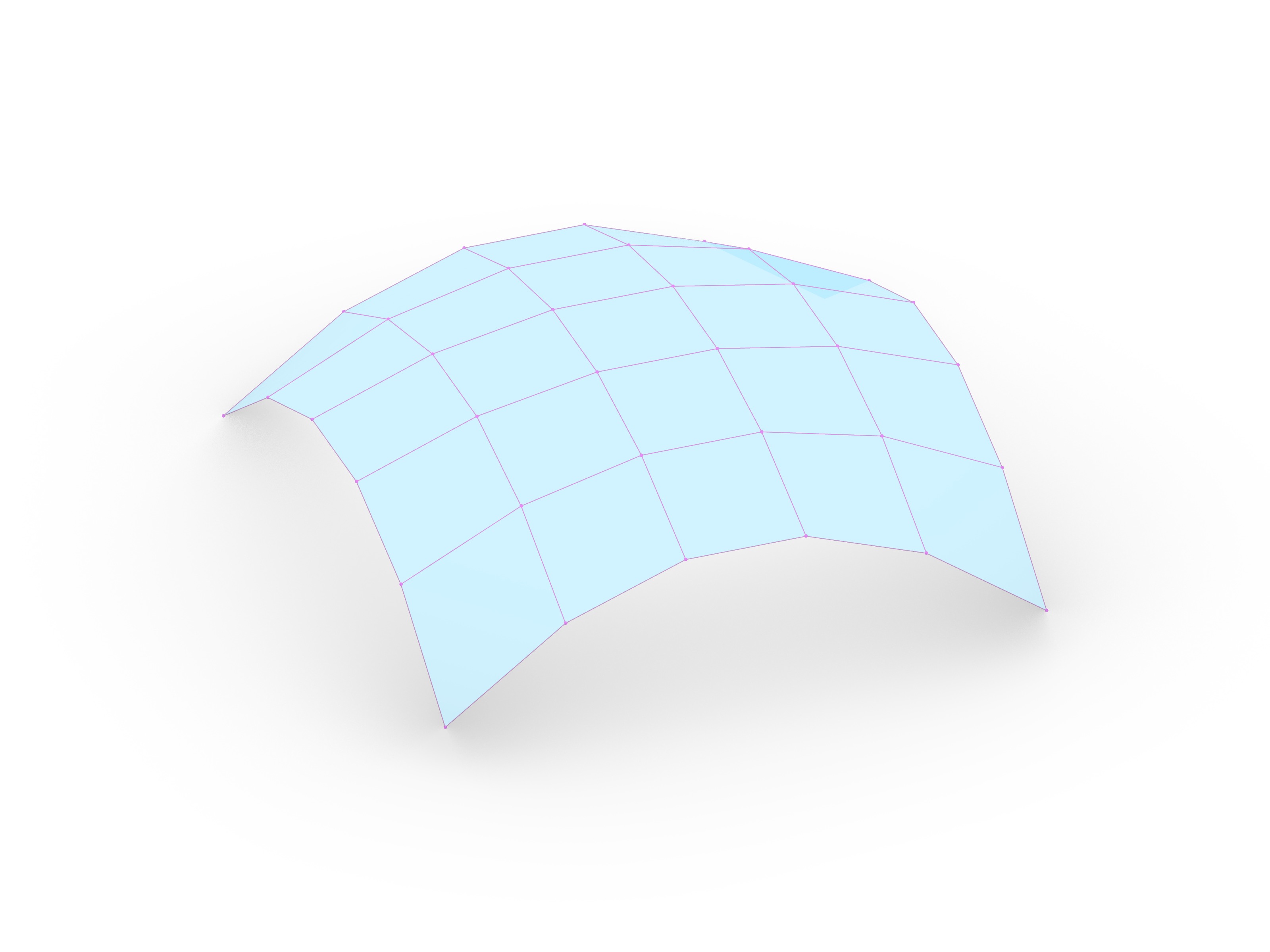
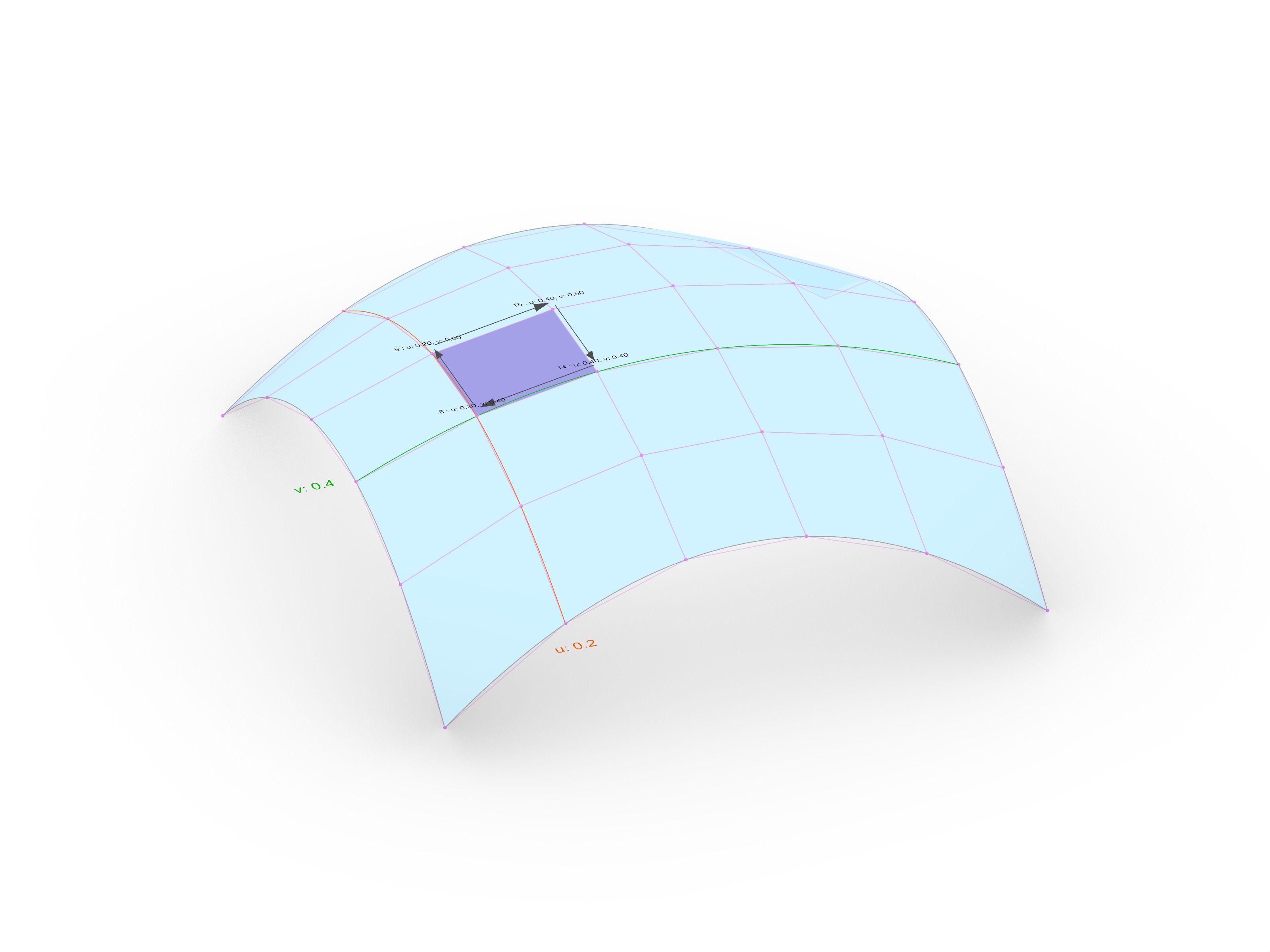
- Sample a Brep surface in UV space.
- Build a
compas.datastructures.Meshfrom sampled points. - Filter mesh faces against a trimmed Brep boundary.
- Store custom attributes on mesh edges (
centerline,normal,next_edge,prev_edge). - Convert abstract geometry (lines) into timber elements (
Beam) and joint logic (JointRules).
Assignment Overview
The assignment is split into three layers in three separate Python files:
- Meshing (
a01_mesher.py)- Build a mesh from a single-face Brep.
- Start with the quad mesher.
- Optionally extend to other topologies.
- RF logic (
a01_rf_system.py)- Use mesh edges as reciprocal-frame beams.
- Compute edge-to-edge relationships and editable centerlines.
- Timber model (
a01_timber_model.py)- Following up on A00, this version of
TimberModelCreatoris designed to work with the RF system instead of just lines. - Turn RF centerlines into beams.
- Apply joint rules and process joinery.
- Following up on A00, this version of
Main Task
- Create a
QuadMesherclass:- The class should take a Rhino Brep as input and generate a
compas.datastructures.Mesh. - Focus on creating a Quad Mesh that follows the surface’s UV logic.
- The class should take a Rhino Brep as input and generate a
- Integrate the mesh into the
RFSystem:- Use the mesh faces to define the centerlines of a reciprocal frame.
- Ensure that each edge carries the necessary attributes:
centerline,normal, and connectivity (next_edge,prev_edge).
- Materialize with
compas_timber:- Implement the
TimberModellogic to convert the RF system into a 3D timber structure. - Use appropriate
JointRulesor direct joint assignments forXLapJoint,TButtJoint, andLMiterJoint(or explore other joint types available in thecompas_timberlibrary).
- Implement the
- Topics: Brep geometry, Mesh datastructures, Reciprocal Frames, COMPAS Timber Model.
Challenge 01
- Vertex-On-Face: Implement a method to check if a generated mesh vertex actually lies on the Brep’s face to allow for trimmed surfaces or surfaces with holes.
- Topics: Geometry (Point in surface, Closest point), Brep topology.


Challenge 02
- Alternative Topologies: Add
TriMesherand/orHexaMesherclass implementations. - Reuse as much logic as possible (sampling, filtering, cleanup).
- Test whether your RF logic still works with different valencies.
- Topics: Mesh subdivision, Dual meshes, Hexagonal grids.


Deliverables
Submit the following files:
- Grasshopper File (
.ghx)- File Name:
mustermann_max_A-01.ghx
- File Name:
- All python files (
.py):a01_mesher.pya01_rf_system.pya01_timber_model.py
- Screenshots (
.png)- File Name:
mustermann_max_A-01_xx.png - Dimensions:
3200 x 2400 px - View:
Parallel,Shaded
- File Name:
Submission
Upload the assignment via POLY.GRADE