Assignment 02: Mesh Relaxation + Reciprocal Frame
Goal: Create a
MeshRelaxerclass to perform iterative spring-based relaxation on a mesh, ensuring it stays within boundary constraints and snaps to a target surface. This relaxed mesh will serve as the refined geometry for your Reciprocal Frame system.
Your starting point is a02_mesh-relax.ghx. It includes a scaffold and in-place guidance comments. This line-by-line guidance can be ignored if desired to implement in a different way. Most of the coding work will be done in the Python files, but the Grasshopper file will be used to call the code in the Python files.
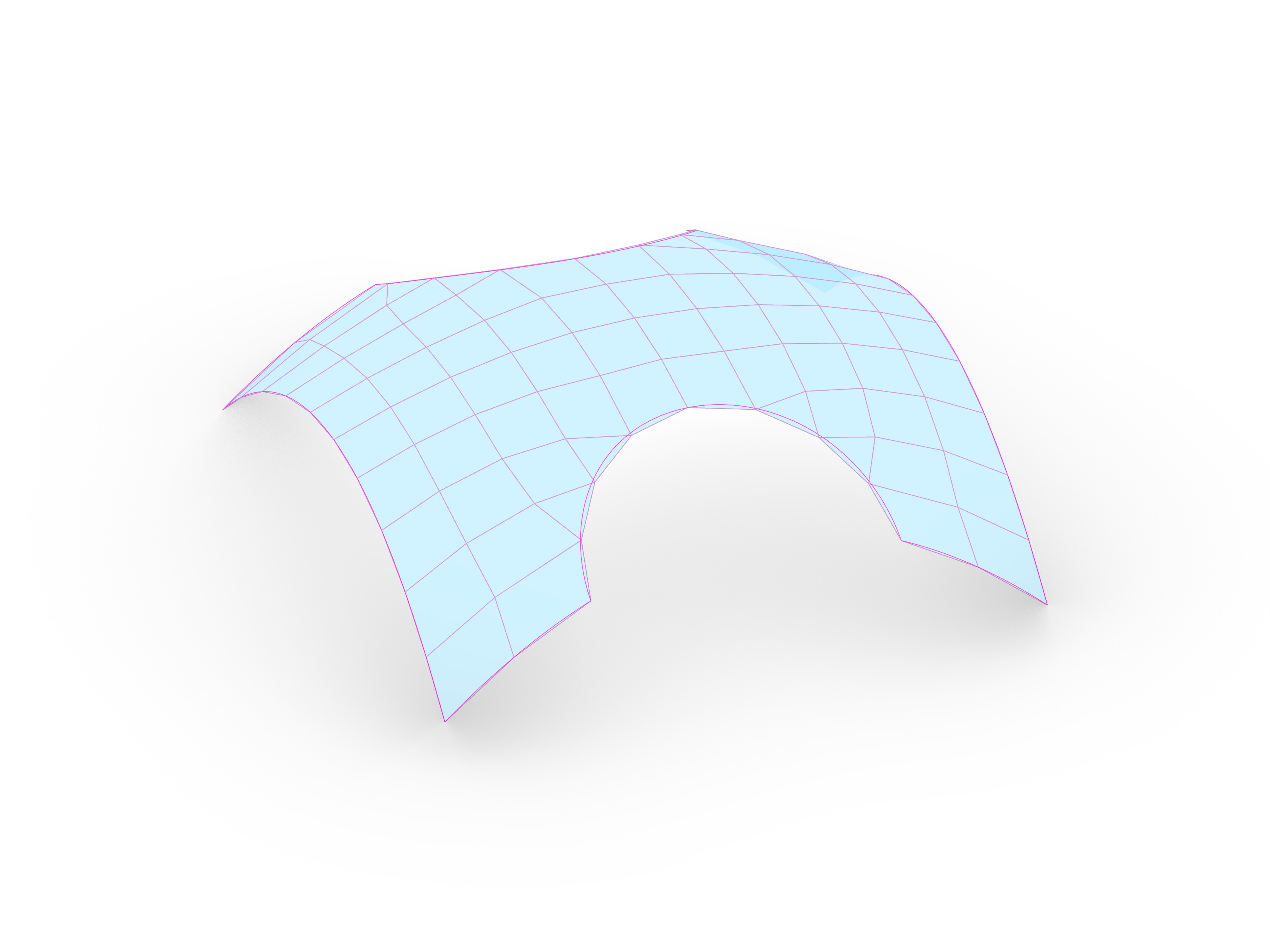
Learning Goals
By the end of this assignment, you should be able to:
- Implement an iterative solver for mesh relaxation.
- Compute interior, boundary, and corner forces to manipulate mesh vertices.
- Apply constraints such as snapping vertices to a target NURBS surface.
- Dynamically adjust geometry using attractor points and curves.
- Design a modular system using classes (Modifiers).
Assignment Overview
Important Starting Note: For files that build upon the previous assignment (a02_mesher.py and a02_timber_model.py), you have two options:
- Continue with your own work: Copy your completed code from the corresponding A01 files into the new A02 files.
- Use our provided solutions: Rename the provided solution files (e.g.,
a02_mesher_solved.py) to replace the blank starter files (e.g.,a02_mesher.py).
The assignment is split into five separate Python files:
- Meshing (
a02_mesher.py)- Re-use or adapt your mesher from A01.
- Mesh Relax (
a02_mesh_relax.py)- Main mesh relaxation logic.
- Modifiers (
a02_modifiers.py)- Contains custom logic to influence the relaxation dynamically.
- RF logic (
a02_rf_system.py)- Manages eccentricity, centerlines, and attractor logic for the Reciprocal Frame.
- Timber model (
a02_timber_model.py)- Turns the relaxed RF centerlines into a 3D timber structure with proper joints.
Main Task
- Implement the relaxation logic in the
MeshRelaxerclass:- Iterative Solver: Create a
relaxmethod that runs for a specified number of iterations.
- Iterative Solver: Create a
- Implement one or more of the following forces and constraints that influence the relaxation:
- Interior Forces: Compute forces that move each vertex toward the average position of its neighbors (Laplacian smoothing).
- Boundary Forces: Implement logic to pull boundary vertices toward a target
Polylineboundary. - Corner Forces: Identify and lock corners or pull them toward specific anchor points.
- Surface Snapping: Ensure vertices are projected back onto a reference
NurbsSurfaceafter each relaxation step.
- Topics: Iterative solvers, Vector arithmetic, Mesh smoothing, Constraint satisfaction.
Challenge 01
- Geometric Eccentricity: Extend the
RFSystemclass and implement methods to eccentrize the RF centerlines based on attractor points or attractor curves. The eccentricity (offset) should vary dynamically depending on the distance to these attractors. You will also need to add a bit of code in the Grasshopper file to use your new methods. - Topics: Attractor logic, Distance-based mapping.
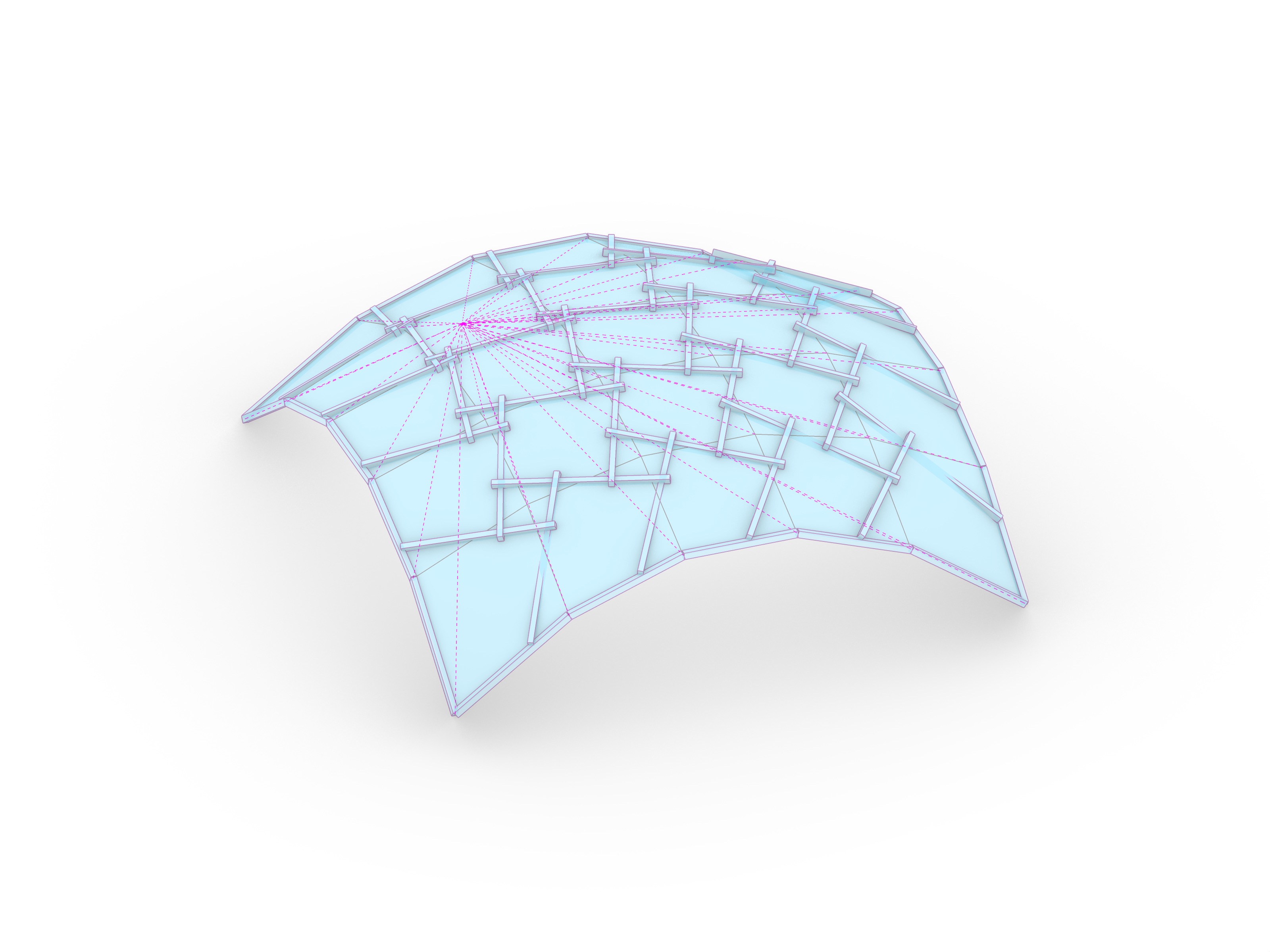
Challenge 02
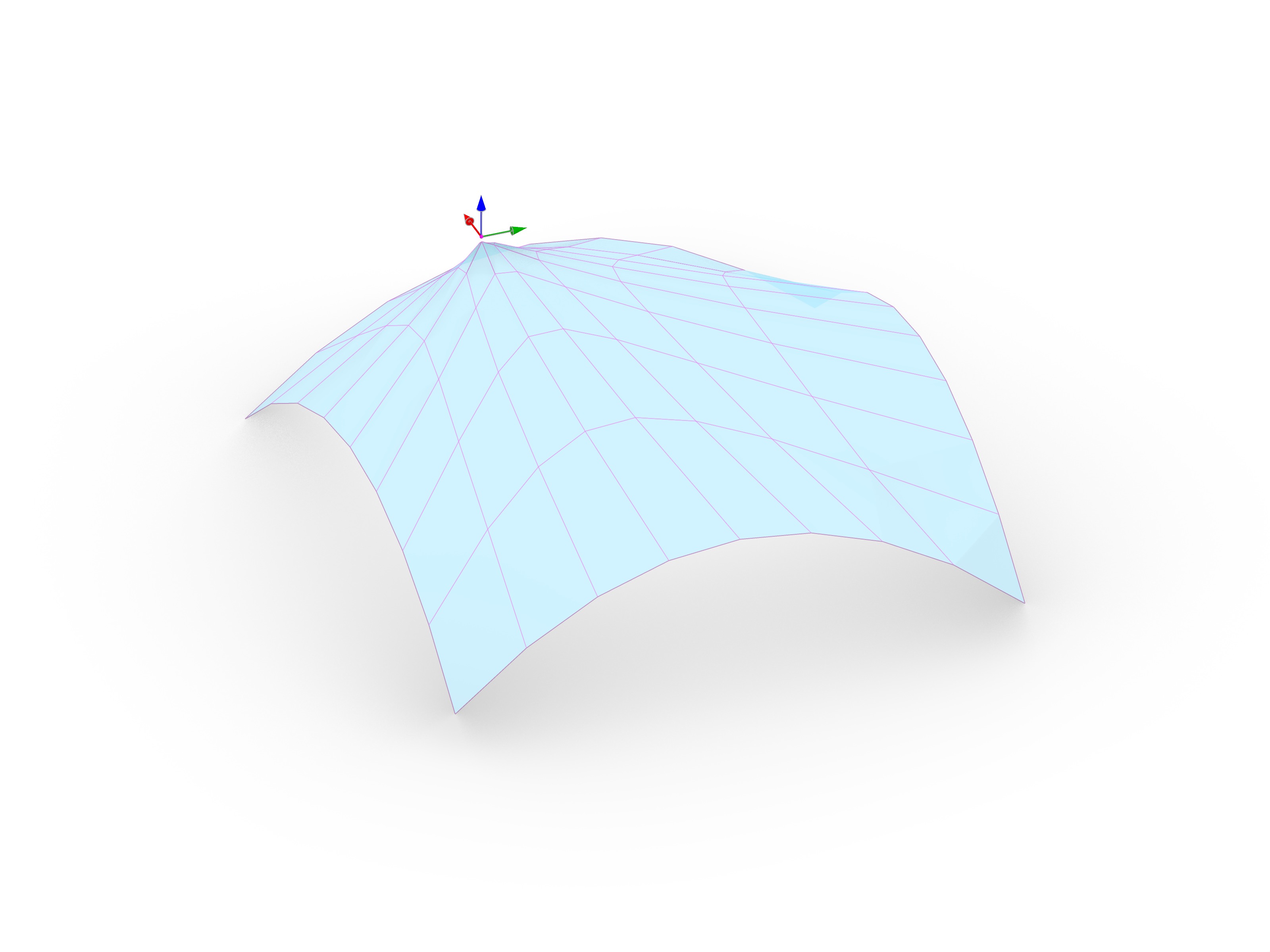
- Custom Modifiers: We will implement an extensible system to add custom behavior to the relaxation process. This will be done by wrapping each modifier logic into a class and the applying those modifications from the
MeshRelaxercode. The task is to create at least one custom modifier. Examples include:- Point Attractor Modifier: Pulls specific parts of the mesh toward a point in space during relaxation.
- Uniform Direction Modifier: Applies a constant force (e.g., gravity or wind) to the vertices.
- Each modifier class should respect a common interface (ie. the same method name and input/output parameters) so that they can be easily added or removed from the relaxation process. In particular, each modifier should have an
apply(self, relaxer, mesh)method that takes the relaxer and the mesh instances and applies whatever logic it needs to apply to the mesh. - You can use the examples in the lecture and integrate them into your assignment, or create new classes.
- Topics: Modular code design, Modifier classes.
Deliverables
Submit the following files:
- Grasshopper File (
.ghx)- File Name:
mustermann_max_A-02.ghx
- File Name:
- All python files (
.py):a02_mesher.pya02_mesh_relax.pya02_modifiers.pya02_rf_system.pya02_timber_model.py
- Screenshots (
.png)- File Name:
mustermann_max_A-02_xx.png - Dimensions:
3200 x 2400 px - View:
Parallel,Shaded
- File Name:
Submission
Upload the assignment via POLY.GRADE